Captures from older Windows software
Some screen-capture, scanning and lab programs still save .bmp. As PNG the same capture keeps its sharp text and becomes small enough to paste into a document or chat.
BMP to PNG keeps every pixel of an ordinary 24-bit or 256-color bitmap and usually stores it in far less space. Most BMP files are saved without compression, which is why one screenshot can weigh several megabytes. PNG holds the same pixels losslessly, so a bitmap like this looks exactly the same and only the file gets smaller; screenshots and graphics shrink the most, photos the least. Three things can differ: the DPI value is not carried over, some 32-bit files lose their transparency, and one color value of some semi-transparent pixels can change by 1 on the 0–255 scale, as explained below. PixVibe converts the file on your own device without uploading it, which matters for scans and screenshots that may hold private data.
In PixVibe's tests in Chrome (November 2026), we converted our screenshot, diagram and photo, compared every pixel of each PNG with the original bitmap and found no differences. PNG compresses without throwing detail away.
A 32-bit BMP that uses a V5 header (BITMAPV5HEADER) with an alpha mask keeps its see-through areas: in our 800 × 800 logo test, all 640,000 alpha values matched. But a 32-bit file written with the basic 40-byte header (BITMAPINFOHEADER), still used by some programs and image libraries, can come out opaque, with black where the see-through areas were.
The tool has two settings: Mode (Fast, Compact or Quality) and “Reduce colors”, which stays at Lossless unless you pick a number of colors. Fast uses the browser's built-in PNG encoder. For PNG, Compact and Quality run the same lossless optimizer and give the same file: either one took our photo from 3.77 MB down to 2.59 MB with identical pixels.
Converting one bitmap needs no sign-in. Log in for free to drop in as many as 20 BMPs together; the PNGs come back in one ZIP.
| Test BMP (made by us) | BMP size | PNG size (Fast, Chrome) |
|---|---|---|
| Screenshot, 1600 × 1000, 24-bit | 4.8 MB | 98.4 KB, 98% smaller, same pixels |
| Diagram, 1600 × 1000, 8-bit (256 colors) | 1.6 MB | 208.4 KB, 87% smaller, same pixels |
| Logo with transparency, 800 × 800, 32-bit (V5 header with an alpha mask) | 2.56 MB | 67.3 KB, 97% smaller, transparency kept (all 640,000 alpha values matched; 2,446 of 105,230 semi-transparent pixels off by 1 in one color channel) |
| Photo, 1600 × 1000, 24-bit | 4.8 MB | 3.77 MB, 21% smaller, same pixels (2.59 MB on Compact) |
Some screen-capture, scanning and lab programs still save .bmp. As PNG the same capture keeps its sharp text and becomes small enough to paste into a document or chat.
Help desks, application portals and website editors often cap uploads at a few megabytes and may not list BMP at all. For screenshots and graphics, a PNG of the same image usually fits both rules; for photos, a JPG is the safer choice.
Game assets, microcontroller displays and image-processing samples often come as bitmaps. PNG keeps them exact for documentation, repositories and the web.
Choose a .bmp file or drop it into the box. Output is already set to PNG, Mode to Fast and “Reduce colors” to Lossless, so the conversion starts by itself. With a free account you can line up as many as 20 files, then press “Convert all”.
Pick Compact for a lighter lossless PNG, or set “Reduce colors” to 256 colors when a photo must be smaller, then press “Convert again”. Every run stays as a version that shows its size.
Save one picture, or every result in a single ZIP.
A BMP is big because it usually stores every pixel uncompressed. Converted to PNG, PixVibe's test screenshot came out 98% smaller and the test photo 21% smaller. The Library of Congress description of BMP (fdd000189, checked 15 November 2026) notes that “In practice most BMP images are uncompressed”. A 1600 × 1000 picture at 24 bits per pixel therefore takes 3 bytes for each of its 1.6 million pixels, about 4.8 MB (1 MB = 1,000,000 bytes), no matter what it shows.
PNG compresses without loss, so the saving depends on the content. On Fast in Chrome, our screenshot went from 4.8 MB to 98.4 KB, a 256-color diagram from 1.6 MB to 208.4 KB, and a transparent logo from 2.56 MB to 67.3 KB. A photo is different: grain and gradients leave little to compress, and ours shrank only 21%, to 3.77 MB. Compact brought it to 2.59 MB with the same pixels; “Reduce colors” at 256 colors reached 1.04 MB, but that setting is lossy. If a photo has to be really small, a JPG made with the JPG converter is the usual answer.
In PixVibe's tests in Chrome (November 2026), a 32-bit BMP that uses a V5 header (BITMAPV5HEADER) with an alpha mask kept its transparency as a PNG, while one written with the basic 40-byte header (BITMAPINFOHEADER) came out opaque, often with black where it had been transparent. Microsoft's documentation of BITMAPV5HEADER (checked 15 November 2026) describes an alpha mask that “specifies the alpha component of each pixel”, a header field that tells programs which byte holds transparency. For this test we drew a separate 400 × 400 logo (not the 800 × 800 one in the table) with a clear background, soft edges and a 50%-transparent ring, saved it three ways and converted each with PixVibe's BMP to PNG tool.
V5 header with an alpha mask: the PNG kept the transparency, and every alpha value matched.
Basic 40-byte header, alpha written into the fourth byte of each pixel (some programs and image libraries still save it this way, including Pillow 12.2, the Python imaging library (the version we tested)): that byte was ignored and the PNG came out fully opaque. The clear areas turned black in our file, because they show whatever color was stored there. The preview in the tool already shows this before you convert.
Basic 40-byte header, fourth byte all zeros: the PNG was opaque and showed the stored colors exactly; it did not turn invisible.
If a logo arrives with a black box around it, export it again from the program that made it, straight to PNG. In the case that kept transparency (the V5 header with an alpha mask), 1,219 of the 29,056 partly transparent pixels changed by 1 on the 0–255 scale in a single color channel. The tool draws the image on a browser canvas, and under the HTML standard a canvas stores semi-transparent colors premultiplied by their alpha, a conversion the standard describes as lossy for colors that are not fully opaque. Canvas rounding changed one color value of some of those pixels by 1; fully opaque and fully clear pixels were exact.
In PixVibe's tests in Chrome (November 2026), the BMP to PNG tool converted most unusual BMPs: RLE8 and RLE4 compressed files, a top-down bitmap (stored with a negative height), 1-bit black and white, 4-bit, 16-bit (565 and 555), and files with the old OS/2 and the V4 headers. All came out the right way up, and the palette and 24-bit ones matched the original pixel for pixel. A 16-bit file shows the colors it actually holds: our red of 220, 30, 30, saved as 16-bit 565, came back as 222, 28, 25, because 16 bits hold fewer shades.
Two kinds of BMP did not convert correctly in these tests. BMPs that wrap a JPEG or PNG inside (compression types BI_JPEG and BI_PNG) stopped with “Couldn't read this image — it may be corrupted or not a real image file.” A file cut off halfway converted without any warning, and the missing half became transparent, so look at the preview when a BMP may be damaged. The tool relies on the browser's own BMP decoder; we tested Chrome only, and other browsers may handle these files differently.
Add the .bmp file to PixVibe's BMP to PNG tool at the top of this page. Output is preset to PNG, Mode to Fast and “Reduce colors” to Lossless, so the first PNG appears without another click; Download saves it.
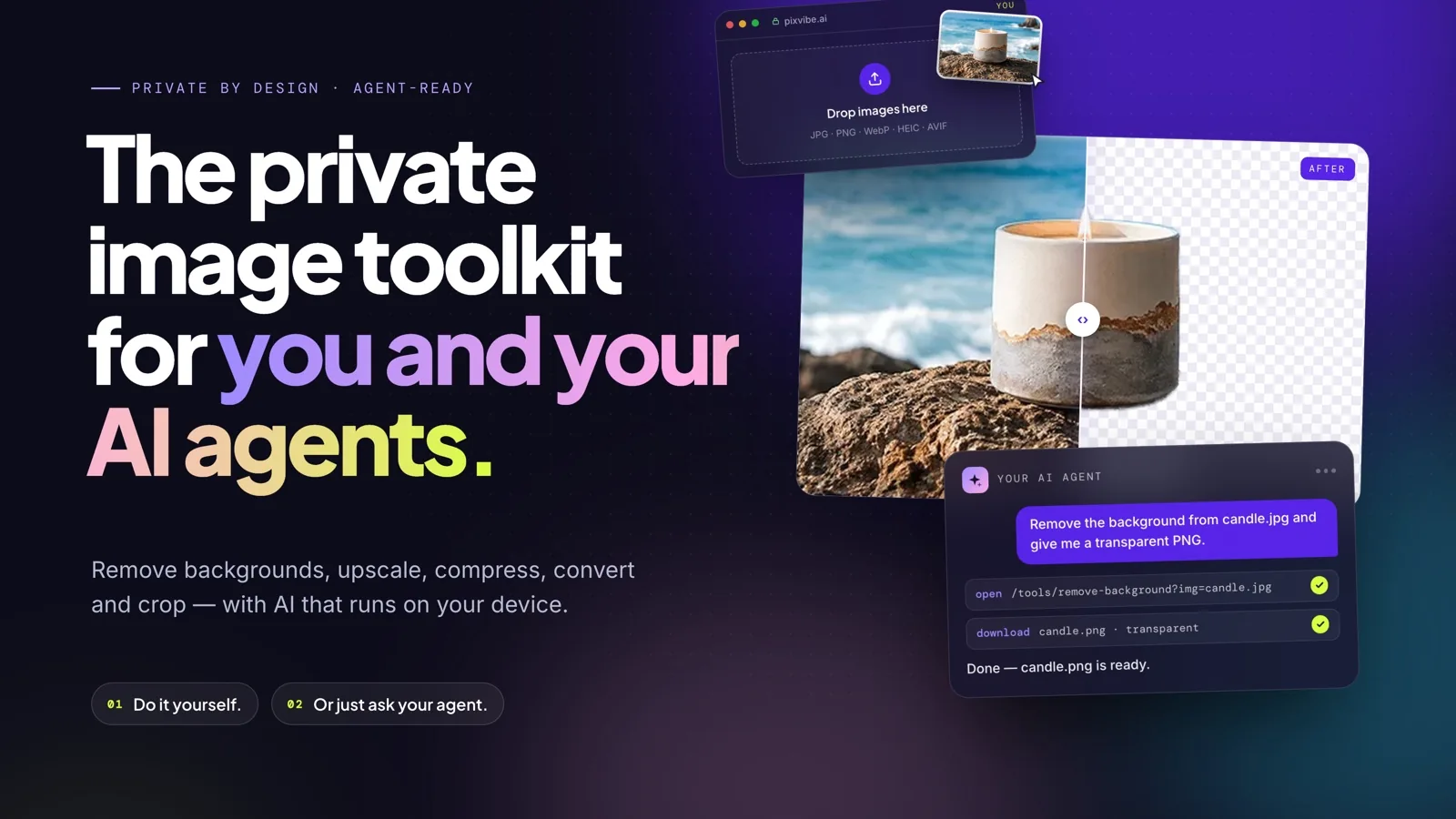
Let an AI agent edit images with PixVibe: one link per job, no API key. We tested Claude, Codex and ChatGPT agent, and show what to check.
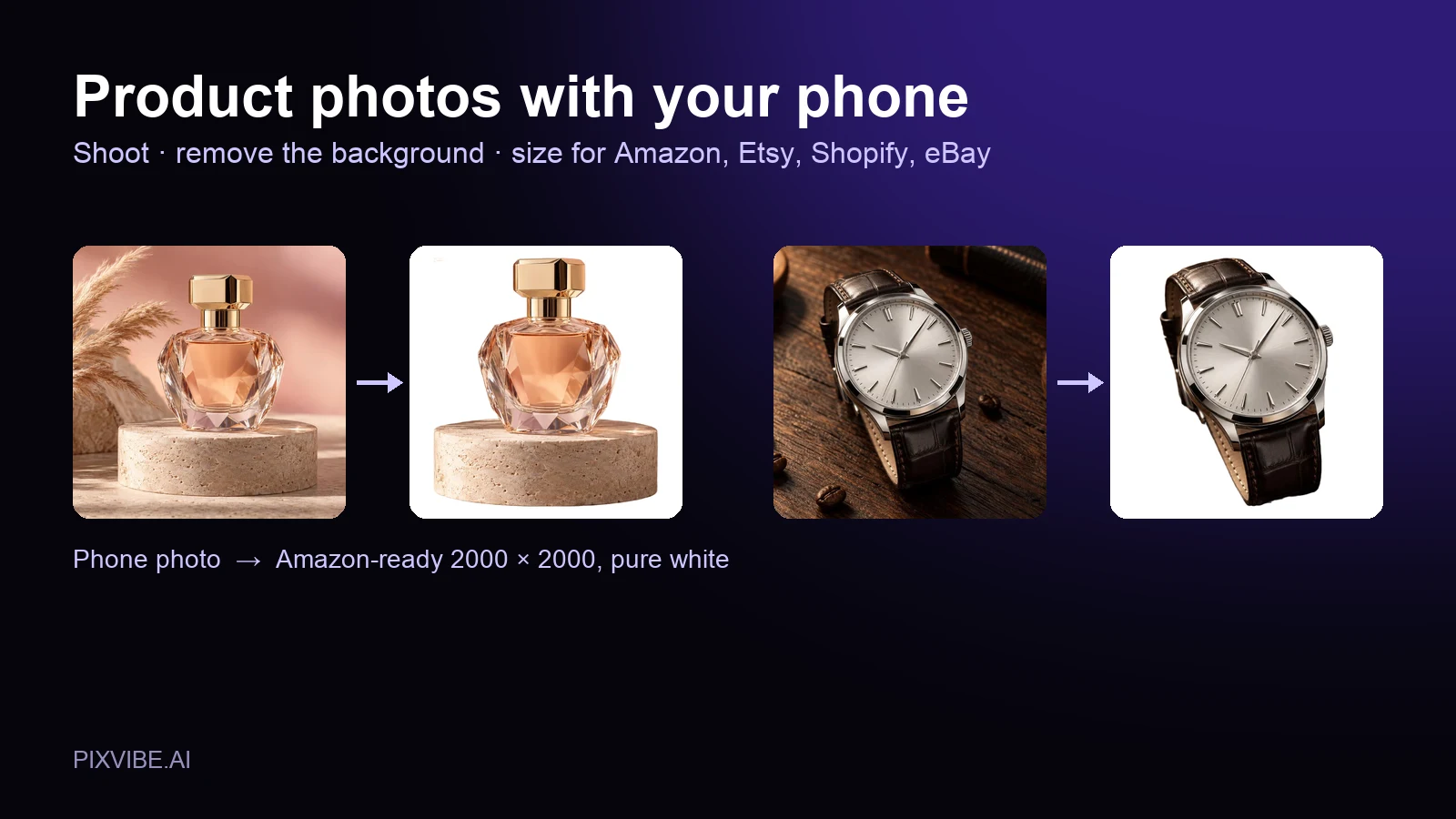
Shoot product photos on a phone, remove the background, and size them for Amazon, Etsy, Shopify and eBay. Official rules in one table.
Free · In-browser processing
 Remove BackgroundMake any image transparent — free PNG.
 Image ConverterHEIC to JPG, WebP to PNG, JPG to WebP & more.
 PDF to ImageTurn PDF pages into JPG, PNG or WebP images — pick pages and DPI.
 Image to PDFCombine JPG, PNG or HEIC photos into one PDF — A4, Letter or fit.
 Compress PDFShrink scanned and image-heavy PDFs, keep selectable text, or hit a target size in KB.
 Passport PhotoFrame your face to passport, visa or ID sizes, change the background and print several on one sheet.
 Compress ImageReduce image size, keep the quality.
 Resize ImageResize for YouTube thumbnails & any size.
 Crop ImageCrop and reframe with precision.
 AI UpscalerAI upscale image resolution up to 4×.
Free · In-browser processing
Server AI · Uses credits